It has been 25 years since the first connected cars came out. In 1996, General Motors Corporation of the United States introduced the world’s first telematics system with the function of networked cars-OnStar, with the main purpose of safety and providing emergency assistance to accident vehicles. At first, the service only provided voice communication, and then gradually increased the sending of GPS position, remote vehicle diagnosis, navigation and so on.
Since the new century, more and more automobile manufacturers have begun to provide networked vehicle services. For example, in 2004, BMW provided online access based on mobile communication, which can check the weather and realize some office functions in the car. After 2008, Apple and Android gradually promoted the combination of mobile phones and vehicles, providing vehicles with a series of services from navigation, rescue to entertainment.
During this period, due to the demand of traffic safety, the transportation industry has gradually put forward some requirements for vehicle equipment, and some concepts such as V2I (vehicle to infrastructure), V2V (vehicle to vehicle communication), V2P (vehicle to pedestrian), V2C (vehicle to cloud communication) and V2X (vehicle to all objects communication) have appeared, so as to improve the safety of using vehicles in society.
In addition, in the context of the rise of the Internet of Things, vehicles themselves have become an integrated system of the Internet of Things. There are as many as 70 sets of systems, equipped with all kinds of testing equipment, to observe and control the operation of vehicles at all times. With the development of technology, the data and transmission mode of vehicles are more multidimensional, which makes vehicles more closely integrated with society and personal life. For example, the address book and schedule stored in the mobile phone can be shared with vehicle navigation; The priority demand of special vehicles is directly informed to all nearby vehicles and pedestrians on the way. The reasonable flow of data is making life easier, more comfortable and more predictable.

The downtown of Shanghai is full of traffic at night. The future car networking will be composed of cars, operating systems and communication services. The Paper reporter Zhou Pinglang
In recent years, the concept and application of connected cars have been very active in China, but it has also produced many confusing scenes. For example, the driver can clearly see the traffic lights at the intersection when he looks up, but in order to reflect the characteristics of car networking, the signal lights are connected to the display screen in the car intact, which makes the driver look down at the traffic lights in the car and ignore the road conditions. This is undoubtedly a dangerous situation.
Networked vehicles or car networking have great commercial prospects, and it is understandable that domestic manufacturers are eager to occupy a position. In this case, it is inevitable that there will be some exaggerated or even harmful traffic safety applications. However, if we want to develop in the long run, domestic manufacturers still need to carefully understand the driver’s needs and traffic safety knowledge, and analyze the real industry rules.
Three kinds of manufacturers developing when getting off the bus and networking.
Domestic literature on networked vehicles or vehicle networking often focuses on two communication modes: DSRC and C-V2X. The former is called dedicated short-range communications, and the latter is called Cellular Vehicle-to-Everything.
However, there is little discussion on the communication inside the vehicle and the on-board operation and control system. Some enterprises focus on the communication between OBU and RSU, even limited to navigation applications. These understandings will also affect the development of China’s car networking.
Nowadays, cars have complex networks, which can detect, sense, connect, reason and operate. Many cars have as many as 70 electronic control units (ECU), which receive more than 2,500 signals from vehicle chassis, powertrain, user interface and safety network. These basic technologies are the foundation of connected cars. It is impossible to discuss the Internet of Vehicles without the vehicle itself.
Taking navigation as an example, some vehicles can use all kinds of positioning system terminals installed by themselves, combined with the speed and angle sensors and the road conditions photographed by the camera, to know the exact location of the specific lane where the vehicle is located. Only by knowing the precise positioning of vehicles can vehicles be networked to solve various risks of road traffic safety, such as collision.
The Internet of Vehicles is inseparable from the capabilities and data of the vehicles themselves. Therefore, car dealers are one of the main participants in the car networking.
In addition, since 2008, Apple and Android have gradually enhanced in-vehicle applications in mobile phone operating systems. In recent years, the mobile phone operating system has been well connected with the vehicle control platform and exchanged data with the vehicle control platform, which has become a part of assisted driving. Take Tesla as an example. Tesla’s vehicles can control vehicle charging, vehicle air conditioning switch, sunroof switch, parking, etc. with their own operating system or applications installed on mobile phones. Even if the vehicle is tested or its performance is upgraded, it can be directly completed through the Internet, and it is an out-and-out networked vehicle.
The model pioneered by Tesla also enables many vehicle parts suppliers to embed some functions that can be communicated and controlled according to the vehicle control system or mobile phone operating system when developing products, so as to meet the market demand and increase versatility.
In the long run, will the automobile industry become a copy of the computer and mobile phone industry-operating system plus standard spare parts? It can be seen that those Internet giants with operating systems may be trying to control the right to speak in the Internet of Vehicles.
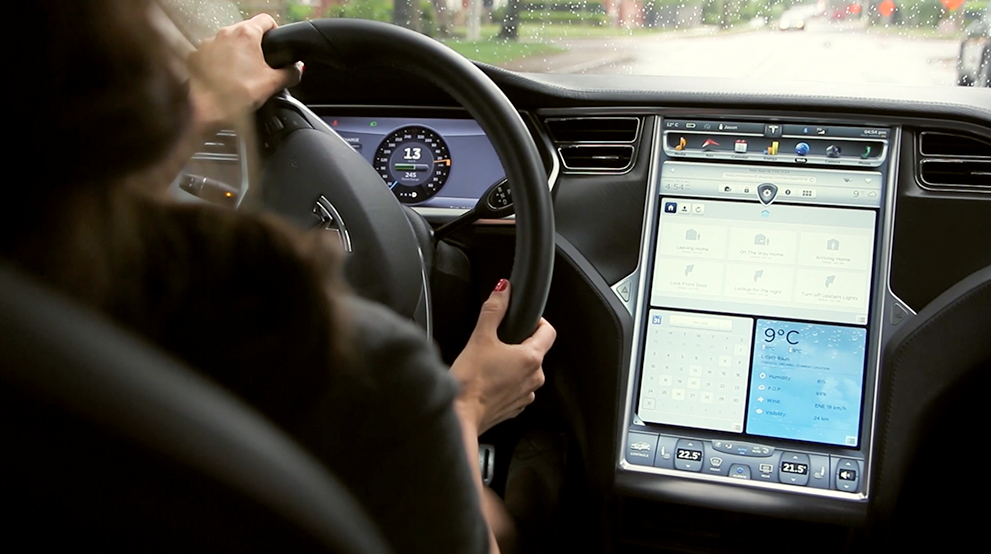
Jason Taylor, http://eve.solutions/
The Internet of Vehicles is a new industry in the world, and the ecosystem is gradually taking shape. But it may take more than ten years to have a stable market. Because in the travel industry, many new technologies are still developing, such as autonomous driving, and their processes are still affecting each other.
However, it can be expected that in the past ten years, the famous automobile manufacturers will still be the main participants. After all, whoever sells more cars will have the right to speak in the formulation of car networking standards.
However, car dealers will also encounter rivals that have never appeared before, namely mobile phone operating system developers or Internet platform companies. In the eyes of Internet giants such as Apple and Android, cars are just another kind of hardware, at most more complicated, and the core of car networking and even vehicles will be systems and applications. It is only a matter of time before Apple and Android get more involved in the automobile industry after they capture mobile phones, tablets, televisions, wearable devices and home control systems.
In the ecosystem of car networking, there is a place for communication manufacturers besides car dealers and operating system developers. The demand of networked vehicles for communication is safe, stable, reliable and fast, and the corresponding technology is difficult for car dealers and internet giants to achieve, or even if it is done, it is not cost-effective. Therefore, communication manufacturers are indispensable participants in the car networking market.
Above all, car manufacturers, internet companies and communication manufacturers are the three most important participants in the car networking market.
With the promotion of the Internet of Vehicles, the original automobile industry will gradually innovate. In the process of gradually establishing a new ecology, many enterprises that had nothing to do with vehicles can integrate into it and gain new business opportunities. The original ecology of the automobile industry may not be subverted, but it will also be integrated into the new ecology. Supporting enterprises that make hardware may be eliminated if they can’t actively integrate.
After all, in the future, people may want to use more connected vehicles with rich functions, just as smart phones gradually replace feature phones.
It is predicted that by 2025, the global shipments of connected vehicles will reach more than 77 million, and it will not take long for connected vehicles to become mainstream on the road. Networked vehicles have rich new functions, which make driving more comfortable and safe. This also means that the on-board operating system and application software will become more and more important, and the value brought by networking will gradually exceed the value of vehicle hardware itself.
Take OnStar as an example, the basic service fee is about $15 per month. Some analysts believe that drivers or insurance companies are willing to pay for remote vehicle diagnosis, anti-theft vehicles and entertainment. Just as the cumulative payment for various applications on mobile phones, such as watching videos, listening to music, reading books, etc., has gradually exceeded the price of mobile phone hardware, will there be such a trend in car networking?
When China gets off the Internet, it focuses its research and development on communication. This is related to the present situation of industrial competitiveness in China. In addition, most of the current purchasers are public sectors, and they don’t have a deep understanding of industry and technology trends, and their goals are too blind or too idealistic.
If we carefully understand the future trend of the Internet of Vehicles, we can realize that the investment in the projects of the Internet of Vehicles should be dispersed to different technical fields, so that the overall technical layout will be more balanced, and the three types of manufacturers and the main service target of the Internet of Vehicles-the technology in the field of traffic safety will be fully developed, and it should not be biased towards a certain type of technology. If no adjustment is made, China enterprises will not be able to enter the real field of car networking, and may only make large mobile phone terminals at most.
What data does the vehicle exchange with the outside?
At present, domestic reports on the Internet of Vehicles have made it difficult to distinguish between the Internet of Vehicles and large smart phones. This is related to the domestic industrial structure and the lack of research on traffic safety. If China still can’t invest enough valuable research on traffic safety, the development of car networking in China may be in the position of following manufacturers in developed countries for a long time.
Cars were not before and will never be smart phones with wheels. If there is a problem in the process of driving, it will not only be unable to restart like a mobile phone, but also cause serious accidents and even life-threatening. Therefore, in terms of security, stability, confidentiality and privacy, the standards of car networking are much higher than those of smart phones.
Modern cars contain complex and sensitive systems with a service life of at least 10 years, and some will continue to be used as second-hand cars. Ordinary smartphones usually have a service life of 2 to 3 years and are often regarded as disposable devices.
The hardware of the car should have redundancy and stability. The primary goal of vehicle manufacturing is not entertainment or comfort, but safety. In order to achieve safety, the design goal of various control systems and central processing systems of vehicles is to maintain long-term and stable performance under various working conditions, rather than pursuing high-performance computing capacity at that time.
Therefore, the vehicle we buy will not have much extra ability to handle frequent data exchange or external requests except for data processing and exchange of the preset functions of the vehicle. In other words, at present, there are many scenes set in China, and vehicles have no extra capacity to deal with them. Moreover, too much external communication and data processing, more or less appearing on the user interface, may cause the driver to be distracted and violate the safety principle. Even if the function may increase security, it should appear on the user interface carefully according to human requirements to avoid self-defeating. For example, the data exchange with the urban traffic control system on the road should be simply suggested to the driver by sound or image after processing; Or just when the driver is waiting for the red light to be free, tell him how many seconds to wait, instead of giving the timing of the front signal light while driving.
Information exchange between vehicles and the outside has always existed and is necessary. In the era when there is no data exchange ability, vehicles exchange information with the outside through headlights and horns, which can convey very limited information, such as attention, left turn and right turn, which takes a long time to convey and sometimes leads to misunderstanding. Now, the technology has developed to the ability to exchange data between vehicles and the outside.
Then, the question is, what data should the vehicle and the outside exchange?
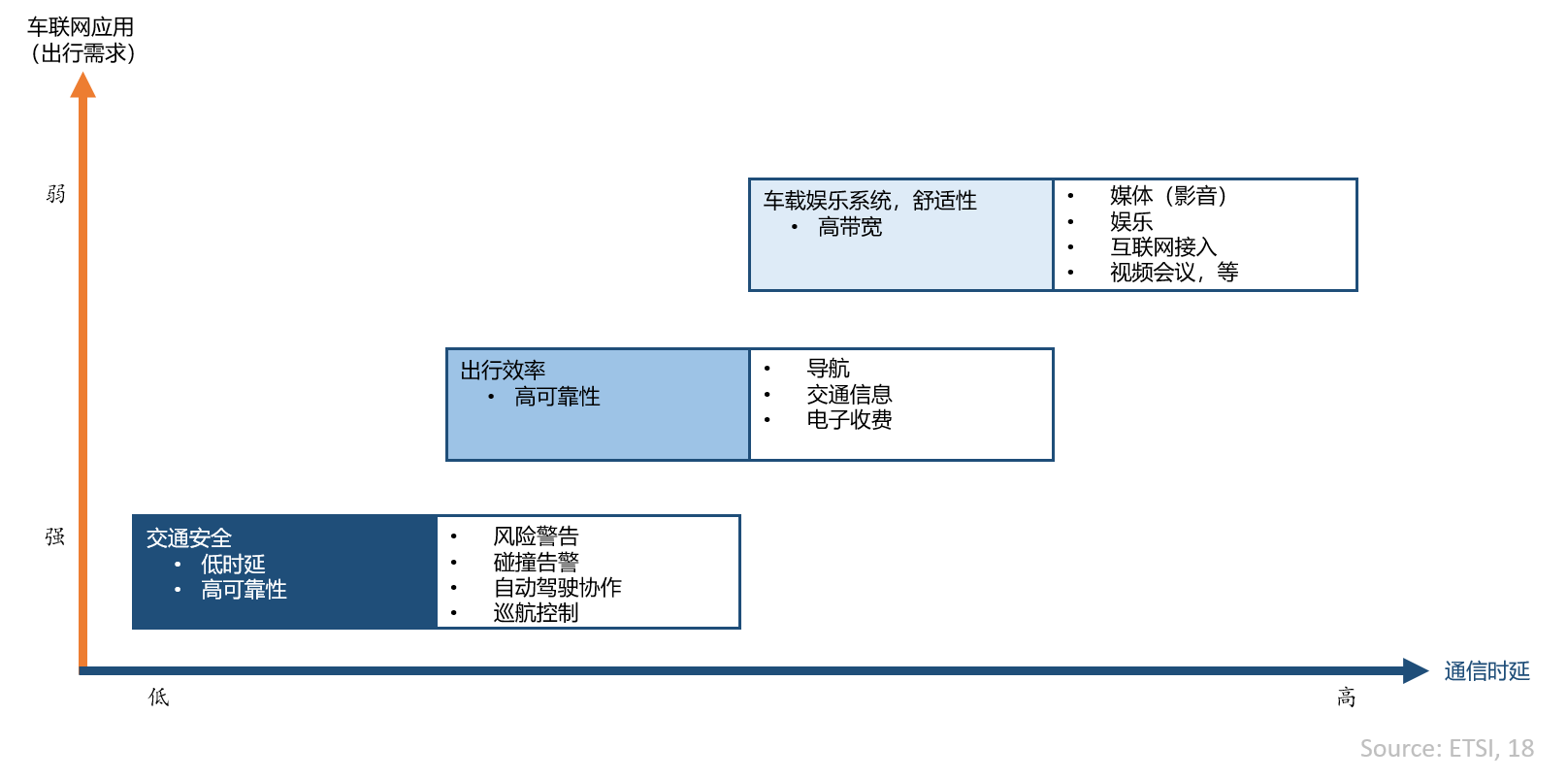
This first needs to be understood from the driver’s needs. Buying a car is often for the sake of efficiency first. It is faster to drive children to school and commute by themselves than to walk by bus or bike, which can make the family sleep more. Secondly, comfort, such as avoiding all kinds of transfer troubles. However, the premise is safety, which is the most important factor for car owners to consider. The same is true for the demand for data exchange between vehicles and the outside. The first thing that needs to be exchanged is safety data, the second is efficiency, and the last is comfort-related data, similar to listening to songs and chasing dramas. Therefore, there are three kinds of data exchange and application functions to be realized by the Internet of Vehicles: traffic safety, travel efficiency and entertainment, and the importance is from high to low, and the requirements for real-time communication are also from high to low. As shown in the figure below.
Vehicles are huge and complex systems. For vehicles, the function of vehicle networking is not an independent or plug-in system, but a part of advanced driver-assistance systems (ADAS). The development of vehicles has always been accompanied by the development of assisted driving system. Traditional auxiliary systems include steering wheel booster which is convenient for the driver to hit the steering wheel, and anti-lock braking system (ABS) which prevents the vehicle from being uncontrollable due to tire locking. Modern vehicles are equipped with more devices to assist drivers in driving, such as lane keeping assistance system with cameras to assist drivers not to deviate from the lane, and front anti-rear-end collision warning system with radar to detect the distance and speed of the preceding vehicle, which can help drivers to drive easily.
The function of car networking is to add more information to the existing driving assistance function. For example, the speed and position data of the front, rear, left and right vehicles, knowing the road alignment and roadside edge conditions, and knowing whether there is a construction work area or weather conditions ahead, these new data, combined with the original data of the auxiliary driving system, will make the vehicles stronger and safer. Even self-driving vehicles also need driving assistance, and the information provided by the Internet of Vehicles can also improve the safety of self-driving.
The essence of the Internet of Vehicles is to improve the assisted driving ability of vehicles, whether it is manual driving or automatic driving. The vehicle networking system is inseparable from the system of the vehicle itself. If the plug-in vehicle terminal of Internet of Vehicles can’t be closely integrated with the vehicle system itself, but is only a large mobile phone screen, it can only realize entertainment function and part of efficiency function at most, so it can’t be called real Internet of Vehicles, and it can’t be regarded as a vehicle driving assistance system.
For these plug-in car networking systems, the communication delay requirements become irrelevant. Because the requirement of low communication delay in vehicle networking is aimed at the requirement of data exchange between vehicle systems. For example, some car networking applications with collision warning require communication delay of 0.1 seconds or less, so that vehicles can react automatically and act immediately to avoid collision. The plug-in system is difficult to combine with the vehicle system and cannot remind the vehicle control system to act. If this information is provided to the driver, and the communication delay of 0.01 second, 0.1 second or even 1 second is not much different from the driver’s reaction ability, then it is meaningless to discuss whether the communication of vehicle networking is DSRC or C-V2X, or the difference between 4G and 5G mobile communication.
The Internet of Vehicles should be the first part of the assisted driving system. On this basis, it can be used as a platform for vehicles to exchange data with the outside. If it is a large mobile phone terminal function that plays music and watches videos, or gives drivers a lot of external information such as speed limit and weather for viewing or choosing, it is actually not the core content of the Internet of Vehicles. Few people are willing to spend tens of thousands of dollars to buy a large mobile phone terminal and install it in the car to catch up with the drama. This will not bring benefits to vehicle sales.
After all, the significance of car networking to car manufacturers is the increase in vehicle sales and profits, and the significance to drivers lies in safety. This is the real reason why all kinds of manufacturers and public departments spend money to research and develop the Internet of Vehicles.
We must abandon words and develop the Internet of Vehicles in a down-to-earth manner.
Since the Internet of Vehicles is a part of the assisted driving system, the development focus of the Internet of Vehicles technology is of course vehicles: improving the cost performance of vehicles and forming a more profitable business model.
This is the same as other new technologies emerging in the transportation industry in recent years. The business models behind autonomous driving, car sharing, and easy service are all for profit. Of course, for society, the new business model will also bring benefits about safety or efficiency.
At present, the commercial meaning of new terms in the transportation industry, such as vehicle-road coordination, remote sensing intelligent driving, intelligent network connection and high-precision map, is often ignored in the corresponding discussion, and its connotation and extension are expanded at will through imagination, forming a lot of specious words.
For example, there are often articles that say, "In a block with an Internet of Vehicles network, pedestrians or other targets are connected to the traffic control system, and the information on the road will share the location information with the approaching vehicles through the cloud. After the vehicles perceive it, they will take the initiative to avoid it." If you think about it carefully, no matter from the technical or commercial point of view, this kind of formulation is confusing.
Technically speaking, first, will there be such a powerful neighborhood? What is the accuracy rate of such a neighborhood with accurate information? Will there be worse results if it is inaccurate? Second, how much information should be transmitted to the vehicle, whether the vehicle has the ability to receive or process this information, and whether it will cause an accident due to system crash? Third, after the vehicle senses it, it will take the initiative to avoid it. Who does this initiative mean, stepping on the brakes to avoid it, the driver or the vehicle assisted driving system? From a commercial point of view, what is the cost of building such a block with accurate information? Who will receive the money? And so on and so forth.
The new technology recognized by the market is either to reduce costs or improve efficiency, or both. The same is true for the Internet of Vehicles. It is not very useful to emphasize the advanced or novel technology. Whether it is the cloud or the coordination of vehicles and roads, if it does not conform to the rules of the market economy, it will be abandoned sooner or later. And transferring part of the cost from the end-user driver to the public sector, hoping that the road or city management department will bear the cost of car networking promotion, which actually secretly cuts away the money of medical care, education and old-age care for ordinary people. Is this good or bad for us?
The development of car networking industry should follow the principle of market economy. Simply put, it means low cost, users benefit and strong competitiveness. From the previous analysis, the Internet of Vehicles is an industry that is beneficial to safety, efficiency and comfort, and it is an emerging industry that conforms to the principles of market economy. There is a consensus on the corresponding bright future, and the problem lies in the path of development. If the path goes wrong, the industry will still develop, and we will fall behind.
The above-mentioned confusing scenes often appear in the press releases of manufacturers or the words of industry researchers, and often become the reasons for project establishment. However, it can’t be justified when it is true. The speaker often slips from the concept of car networking to the field of collaborative intelligent transportation, and then turns to the concept of autonomous driving. The explanation is erratic and can only be made up by words. Although words are beautiful, they are of no help to industry.
With the advantages of huge scale and complete types in manufacturing industry and logistics industry, as well as the advantages of related systems, the environment for developing car networking in China is very superior. However, in the development planning of car networking in some regions and industrial associations in China, there are often ambiguous new words, big words and function words, which express the idealized scene setting-assuming that there is data, the data transmission is stable, reliable and credible; Suppose you are capable and powerful but you don’t know who the subject is. You know, the Internet of Vehicles has to study the degree of "stability, reliability and credibility", rather than taking these contents that should be the focus of promotion as existing assumptions. This arbitrary setting discards the real content that should be studied in the Internet of Vehicles, and also makes the path development too arbitrary. As long as language processing, no matter what kind of scene, can become a part of the car networking industry and be supported, so the bubble gradually accumulates.
China’s car networking industry should be promoted by three kinds of car networking related manufacturers, and the details of vehicles, internet and communication are indispensable. The relevant public departments, such as laws and roads, should make demands on laws, privacy, public attitudes and road safety to guide and assist manufacturers to make progress.
Like manufacturers, the public sector is an integral part of the industry, but it is not the protagonist, and it should not be the main buyer of the development of the car networking industry. Buyers can only be drivers, transportation companies and other social institutions with travel needs. If the public sector gives corresponding support, mainly to pay for projects, rather than strengthening rules, protecting public interests and purchasing public services, it will mislead the development direction of the Internet of Vehicles, making it difficult for manufacturers to get rid of public funds, or even the path deviation.
The long-term existence of OnStar, the first application of the Internet of Vehicles, proves that ordinary drivers are the buyers that the Internet of Vehicles should pay attention to. Under the public sector’s capital investment, the corresponding situation should not be worse than no investment.
As a manufacturing country with a large population, China’s public sector should invest more rationally and intelligently to encourage industrial development. Even if investment or subsidies, should also be based on the sense of gain of the people as an indicator of evaluation and measurement, such as the following:
First, in terms of public services, a demonstration of the application of car networking is formed, which aims at the second type of application of car networking: efficiency, and measures the application of car networking with the final efficiency progress. Public transport, urban freight transport, municipal vehicles, official vehicles and special vehicles in China should cooperate with the application and promotion of vehicle networking manufacturers to improve their service capabilities. For example, paying for ambulances and fire engines to arrive at the scene quickly, taking the efficiency of response and arrival as the payment condition, and really promoting the industry.
Second, encourage close integration with car networking enterprises, and form car networking applications in closed sites or fixed lines such as parking lots, bus stops, office parks, industrial parks, etc. This still belongs to the efficiency category, and use car networking technology to improve the safety and efficiency of closed sites. However, before these applications are implemented, the objectives and evaluation methods should be clear. For example, improve the punctuality rate of buses, promise the reliability of bus services, and pay service fees according to punctuality.
Third, we should select some vehicle networking applications, such as weather service on expressways, early warning in construction areas, giving priority to signals of special vehicles at intersections, and promoting road safety and efficiency, and make practical application results in some cities and expressways.
tag
Regardless of legislation or technology research and development, Europe is several years ahead of China in the field of car networking. This is related to the advantages of traditional industries in Europe. However, China still has the opportunity to catch up, and it also has certain industrial advantages, such as communication and Internet services. However, the operation of enterprises can only be successful if they truly conform to the laws of the market and make technologies that make people truly feel gained. In the car networking industry, commercial success means technological leadership. After all, the growth of car sales and service profits means the sustainable development of car networking.
However, the situation with words and the creation of new terms as the core should not be encouraged, and it should not be allowed to become an obstacle to the development of China’s car networking.
(Author Guo Min is a traffic engineer in Hangzhou)