[Reporter’s investigation]
Guangming Daily reporter Chai Ruzhen
In 2022, the national postgraduate entrance examination kicked off on the 25th.
In the examination room, the candidates worked hard; Under the examination room, many college students who plan to take the postgraduate entrance examination have already begun to think about what majors, universities and degree types they want to apply for in the coming year. Many college students frankly said, "You can’t tell a master from a master." Then, why do students learn to master and master, and why do they shrink and rise? Why should we distinguish between two types of degrees? How to choose?
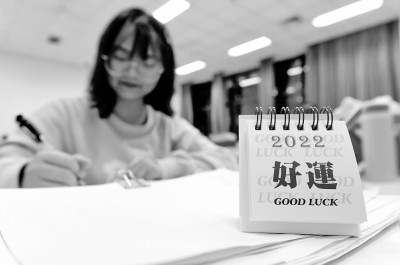
On December 6th, Hebei University of Engineering candidates reviewed in the study room. Hao Qunying photo/bright picture
Trade-offs
Tian Tian (pseudonym), a student at Shanxi University, has always had a dream of Peking University. However, just as she was preparing to apply for a master’s degree in the School of Journalism and Communication of Peking University, she learned that in 2022, the school plans to recruit 10 full-time academic degree graduates, all of whom are recommended for exemption. Without the qualification of insurance research, she can only choose to apply for a master’s degree.
In recent years, under the background of the steady increase in the number of graduate candidates and the enrollment expansion of graduate students, the news that some academic graduate students in some famous schools have reduced or even stopped recruiting has aroused widespread concern and heated discussion, and even some media have used the word "exit" to describe this phenomenon.
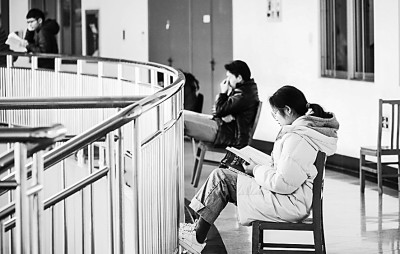
On November 23rd, in Huai ‘an, Jiangsu Province, students who participated in the postgraduate entrance examination reviewed in the library of Huaiyin Normal University. Photo by Zhao Qirui/Bright Picture
The School of Economics of Fudan University issued a circular in official website in May this year, making it clear that starting from 2022, it will no longer recruit academic degree postgraduates. This is not an isolated case: in 2021, the National Development Research Institute of Peking University cancelled the enrollment of master students, and the School of Software of Fudan University no longer enrolled master students with academic degrees; Sichuan University and Fuzhou University have also stopped enrolling students with masters in psychology and information science. In addition, it has become an increasingly obvious trend to reduce the enrollment quota for graduate students, or to guarantee graduate students to study for graduate students only by accepting the recommended exemption.
At the same time, the enrollment scale of professional degree postgraduates is expanding steadily. Education in China — released by the Ministry of Education on November 15th; — The development of national education in 2020 shows that in 2020, 991,000 graduate students were enrolled nationwide, including 602,000 with professional degrees, accounting for 60.8% of the total enrollment of graduate students, an increase of 2.4 percentage points over the previous year. According to the data from the Center for Degree and Postgraduate Education Development of the Ministry of Education, in 2021, there were 1.062 million national postgraduate students, including 657,000 professional degree students, accounting for 61.9%.
2021 is the 30th anniversary of the implementation of China’s professional degree system. By 2020, China has set up 47 professional degree categories, with a total of 5996 master’s degree authorization points and 278 doctoral degree authorization points, which basically cover major industries in China.
"In the postgraduate training stage, professional degrees have become the main body." Huang Baoyin, director of the Center for Degree and Postgraduate Education Development of the Ministry of Education, recently wrote that "in the past 30 years, China’s professional degree education has developed rapidly and achieved remarkable results, from one category to 47, from master’s degree to doctor’s degree at the level, and from recruiting dozens of people every year to recruiting more than 600,000 people every year, and the proportion has increased from less than single digits to more than 60% now. Training institutions have basically covered all postgraduate training units from a small number of institutions to now, and their functions have changed from being a useful supplement to academic postgraduate education to being equally important now. They have never been known to be popular now, and their models have changed from learning to learning. It has more China characteristics and unique advantages. "
Structure optimization
Shen Hangyu, who just graduated from Xinjiang University with a master’s degree in electrical engineering, admitted that he did not struggle when he took the postgraduate entrance examination, and directly chose the master’s degree, because the master’s degree is biased towards engineering application, which can improve the overall employment competitiveness. "Great country craftsmen are my lifelong goal!"
Behind the trade-off between academic masters and specialized masters is the gradual adjustment of the postgraduate training structure in China, so as to better adapt to and play an important role in cultivating innovative talents, improving innovation ability and serving economic and social development.
"The reduction of masters and the rise of masters are not things in recent years, but the embodiment of national policies for a long time." Peng Pai, deputy director of the Institute of Degree and Postgraduate Education of Huazhong University of Science and Technology, told the reporter that before the freshmen were allowed to apply for professional masters in 2009, the proportion of masters was less than 10%; Since then, the enrollment of special masters has begun to increase substantially, and this trend has always been obvious. The 13th Five-Year Plan for the Development of Degree and Postgraduate Education issued in 2017 aims to make up about 60% of master’s enrollment in 2020. Last year’s "Professional Degree Postgraduate Education Development Plan (2020-2025)" put forward the goal that by 2025, master’s degrees will account for two-thirds of master’s enrollment, which is about 67%.
It is not difficult to see that professional degree graduate education will become the main way to train high-level applied professionals in China.
"This adjustment is closely related to the transformation of postgraduate education." Shen Wenqin, an associate professor at Peking University Institute of Education, further explained that in the past, you could enter a university as a teacher after graduating from a master’s degree. However, with the expansion of doctoral enrollment, the threshold of teaching in colleges and universities has also risen. For example, in 2020, China will recruit more than 100,000 doctoral students, but the demand for university teachers and research institutes is around 60,000, which means that 40% of doctoral students may not be able to engage in academic work in universities or research institutes after graduation. In this case, if the orientation of postgraduate education is still simply to cultivate talents in academic departments, it obviously cannot meet the needs of economic and social development, nor does it meet the needs of students’ study and employment. Master’s training needs to be mainly oriented to enterprises and institutions, including R&D talents of enterprises.
On the other hand, with the high-quality development of China’s economy and society, the demand for high-level applied talents in all walks of life is becoming more and more urgent. Peng Pai pointed out, "The general trend of postgraduate training is career orientation, application orientation and practice orientation. Especially in the master’s degree, it is not necessary and impossible to ask everyone to do scientific research after a large number of enrollment expansion. More importantly, it is to cultivate professional ability and the ability to solve practical problems. "
"Don’t simply understand optimizing the educational structure of master’s degree graduate students as increasing the enrollment ratio of specialized masters." Xu Lan, director of the Graduate Education Research Center of Xiamen University, stressed that structural optimization also includes improving the category management mechanism of specialized masters and adding specialized masters according to the needs of social development, which reflects the ability to respond quickly to market changes. In addition, in the future, we should improve the classification evaluation system for different degree types, and guide the development of graduate education to break away from the path dependence of single quantity expansion and develop in a direction of "multiple and high quality".
Various types
Li Jing (a pseudonym), a Chinese medicine major in Tianjin University of Traditional Chinese Medicine, was transferred from a master’s degree to a master’s degree because of insufficient scores. However, after entering the school, it is found that there is little difference between the two in actual learning. Just like studying a course, both of them need to master the experimental operation and complete the thesis experiment. "The biggest difference is the degree certificate, the master is a medical degree, and the master is a science degree.
Both master degree and master degree need to cultivate research ability, so what is the difference between them is also a puzzling problem for many college students.
Peng Pai pointed out from three aspects: training objectives, training methods and evaluation methods that the main differences between master and master are: master pays more attention to knowledge innovation ability, while master pays more attention to practical innovation ability; Master should mainly participate in academic research, and master should participate in professional practice and industrial application topics; Learning to master mainly depends on the academic nature of the paper (such as the rigor of the method and the novelty of the discovery), and mastering mainly depends on whether the paper has the ability to apply knowledge to solve practical problems.
Many experts pointed out that due to the different demand for talents in the labor market, "the goal, method and evaluation of cultivating talents should also be different. Only in this way can we cultivate talents accurately." This distinction of training types is not only necessary, but also the inevitable trend of the development of postgraduate education. From a global perspective, the diversification of degree types is also a common trend.
"We are increasingly accepting the concept of multi-quality, and we should appreciate the beauty of difference brought by this kind of classified training." Xu Lan also admitted that the current postgraduate training is not enough to show the distinction of types, especially in the course content and thesis form. Although there are practical links, most students do not have off-campus tutors, and teachers’ requirements for postgraduate training are usually loose. If the length of study is shorter than that of postgraduate training, and it is not well connected with professional qualifications, it is easy to be labeled as "water release", and the signal function of "postgraduate = practical innovation ability"
According to the results of the national postgraduate study and development survey conducted by Peng Pai and his team, the proportion of master students participating in various horizontal projects is not as good as that of master students, and the horizontal projects directly point to the application ability, so master students should be more involved; Most of the tutors have no difference in the way of cultivating masters, and they are basically cultivated in the same way as in the past, and there is inertia; At present, there is a lack of institutional mechanisms for industry to participate in the training of specialized masters. Peng Pai believes that "it took only about ten years for the proportion of students enrolled in master’s degree to rise from less than 10% to 60%. Therefore, these developing problems need to be solved in development. "
In addition, Shen Wenqin suggested that we should be alert to the "hidden educational equity problem" for the chain problems that may be brought about by the expansion of enrollment of specialized masters. The tuition fee for a master’s degree is often higher than that for a master’s degree, which may affect the further study opportunities of children from poor families. Under the realistic conditions that many jobs require master’s degrees, future policy research or adjustment should fully consider the equity of graduate education.
Finally, for college students who intend to take the postgraduate entrance examination, many experts suggest that: first, clear the goal, find the right position, make a good career plan, don’t follow the crowd and chase after the hot spots, and don’t regard the professional degree as a "water release" choice; Second, we should have a correct understanding of graduate study. Graduate students do not learn well by taking classes and taking credits, but mainly by self-study, with the goal of improving their research ability. Third, in the undergraduate stage, we should consciously participate in the teacher’s research and find our own interests and directions.
Guangming Daily (11th edition, December 25th, 2021)