■ Teacher development and improvement of teacher-child interaction ability ③
The main points of "teacher-child interaction" in the Guide to Quality Assessment of Kindergarten Conservation Education suggest that we should understand children’s learning styles in health, language, society, science, art and other fields, respect individual differences in children’s development, find out each child’s advantages and strengths, and promote children’s development at the original level. Among them, "respecting individual differences in children’s development" is one of the most important principles in the interaction between teachers and children.
Adopt the strategy of differential interaction
Difference is a kind of particularity compared with the general situation. Emphasizing the individual difference of children means focusing on the particularity of children. Individual differences in children’s development involve many aspects, which can be summarized as "quality" and "quantity" in general. The difference of "quality" refers to the difference of characteristics, tendencies or forms of expression in children’s development, and the difference of "quantity" refers to the difference of the degree, quantity or level of a particular ability or performance in children’s development.
Particularity refers to a characteristic, rather than good or bad. To establish the children’s view of "respecting individual differences in children’s development", teachers need to abandon the utilitarian evaluation view, face children with an aesthetic attitude, and present independent, lively and distinctive individuals.
Although most teachers agree with the concept of "respecting individual differences in children’s development" and can identify children’s differences, some teachers have some difficulties and misunderstandings in how to effectively interact with children based on differences due to factors such as traditional teaching paying too much attention to the characteristics of children’s development stages and large class size. The first one: adopt "egalitarianism" to adjust children’s differences and try to make every child reach a certain average level. This may lead to some high-level children "looking down", while low-level children are still "out of reach". The second type: pay too much attention to "superior" children, while paying limited attention to other children. The third type: arranging to replace "weak" children. This may weaken children’s autonomy and learning motivation, and then aggravate children’s polarization.
Based on this, it is necessary for teachers to adopt differentiated interaction strategies in their interaction with children to help each child achieve the best development.
Pay attention to development advantages
"Advantage" is not to show "prominence" in comparison with others, but the uniqueness and flash moment of children themselves. It is very important for children to establish a positive self-concept by focusing on advantages and appreciating and encouraging each child. We encourage teachers to focus on the uniqueness and flash moment of each child (especially those who need extra support and attention in some aspects) and interact with children based on their advantages.
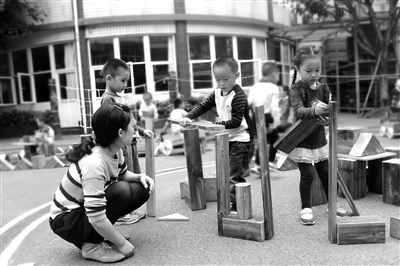
Case 1: Build a door that won’t fall down.
Xuan Xuan, Yilin and Whale, who have weak construction skills, build a house together. After the fence and table were set up, Xuan Xuan tried to erect two long blocks as doorframes, but failed. Yilin suggested putting the long door frame against the wall, and finally succeeded. No sooner had the whale put on the beam than the erected building blocks tilted. Three people repaired the door, but Xuanxuan accidentally touched it and the door collapsed. After being repaired again, they chose not to go in and out from the door, but to play "play house" around the table.
At this time, the teacher pretended to be a guest and deliberately squeezed the door down. Three people skillfully recovered and said, "Teacher Zhou, don’t come in through the door, come in through the fence!" " The teacher replied, "Ah? Climb over the wall, not good. Your door is too small and weak. " Inspired by the teacher, the children found longer and thinner building blocks to repair the door. But it still collapsed when I entered the door. "It’s too narrow." Whale whale said. The children failed to increase the width of the doorframe again, and they began to blame each other. When the teacher saw this, he showed them around the rockets repaired by his friends and asked, "Why don’t they fall down when they repair so high?" Xuan Xuan soon discovered that they were made of square blocks. "Oh, we can also build doors with that kind of wood." Whale whale said.
After that, three children found square building blocks separately and finally succeeded.
Xuanxuan, Yilin and Whale are middle-class children. Compared with others, their construction skills are not high, and they have not mastered the relationship between the shape and stability of materials, and there are still difficulties in overhead. Teacher Zhou didn’t rush to interfere or deny children’s choices, but saw their persistence, concentration and efforts, and guided them to discover the relationship between the shape, stress surface and stability of building blocks through observation. This interactive way can make children feel their own value and ability, and feel that they are capable learners.
Make up for the weak development
The development speed and degree of children in each field will be different. Some children may perform well in one field, but they may need extra support and attention in another. Teachers should not only help children develop their advantages, but also make up for their weak development.
Case 2: Jiayang’s Domino Game
Jiayang likes challenging games, but he is stubborn, doesn’t like his companions to join his games, and often loses his temper.
Once, Jiayang tried to use bullets to row from one end of the classroom to the other. Mao Mao wanted to join in, but Jiayang didn’t agree. The teacher suggested that the two men should swing from both ends and meet in the middle, but Jiayang reluctantly agreed. But the first two times failed, they discussed the reasons together, and succeeded in the third time, which made teachers see the opportunity to guide Jiayang’s cooperative game.
By watching the game video played by the teacher, Jiayang sprouted the idea of making a big circle around the classroom with all the materials. The teacher asked, "Do you need a companion?" Jia Yang replied, "Yes, I can’t do it alone." With the help of teachers, Jiayang called his friends and introduced the plan, which was responded by many children. Jiayang is very happy. He feels accepted and trusted. The task of "challenging the Great Circle" finally succeeded in everyone’s cooperation.
Soon, Komori and Jiayang put a triangle together, and it was about to succeed. Komori accidentally shook the table, and in an instant, all the blocks fell down. I thought Jiayang would get angry, but I didn’t expect him to say calmly, "Forget it, it’s okay, start over, and pay attention next time."
Jiayang is outstanding in cognitive development, practical ability and learning quality, but has a weak awareness of understanding, tolerance and cooperation with others. In view of this weak development, teachers "premeditated" a game that needed cooperation based on Jiayang’s game interest. In this process, we have seen that Jiayang never accepts others to join, but cooperates with others and forgives others’ mistakes. In the game, Jiayang not only played an advantage, but also made up for the weakness.
Support diversified development
Every child has different interests and development needs, and teachers need to provide diversified activities that meet the interests, abilities and needs of different children to support their differentiated development. Regional games are an important way to respond to children’s different interests in differentiated teaching. Teachers can realize this vision by creating rich regional games.
Case 3: Teacher Xiaoyu’s classroom
In order to let every child do what he likes, teacher Xiaoyu’s class has created six kinds of environments. The first category is the environment that supports children’s systematic perception and experience, including the secret of pulp, the art creation area of paper and the hot pot restaurant made of paper; The second category is the environment that satisfies children’s social role imitation, including doll house and photo studio; The third category is the environment that meets the needs of children’s operation and inquiry, including nailing and knocking areas and construction areas; The fourth category is the environment that meets the needs of children’s artistic expression, including fabric area and painting wall; The fifth category is the environment that satisfies children’s closeness to nature and perception of life, including planting areas and feeding areas; The sixth category is the wall environment that highlights the growth process of children and reflects the process of parents’ participation.
Teacher Xiaoyu fully considers the needs of different children and the development needs of the same child in different aspects, and is committed to providing children with a diverse, rich and inspiring learning environment. Through the creation of such an environment, every child can find something he is interested in and get support, so as to achieve comprehensive and personalized development.
Respect special needs
Many teachers have children with special needs in their classes. These children are facing various challenges and need extra attention and support.
Case 4: hyperactive Chen Chen
Chenchen (a pseudonym) can never be quiet, and the teacher tried many ways to adapt him to the normal rules, all of which ended in failure. After medical identification, he was found to have ADHD. This semester, the teacher gave Chen Chen more free space. For example, when doing morning exercises, he is allowed to do what he likes, or he can join everyone’s activities. In the review session of a woodworking game, Chenchen is still wandering around. The teacher asked, "Chenchen, where did your work go?" Did you run away like you? " After Chen Chen heard it, he took out his work. The teacher was very surprised. Chenchen made an airplane seat with hinges. The teacher said excitedly, "Wow, Chenchen, we didn’t expect that, you are great!" " Suddenly, the activity room rang with warm applause, and Chenchen ran away happily.
In the above cases, the teacher established different rules for Chen Chen. This personalized support made Chen Chen more comfortable to participate in class activities, reduced his conflict with the routine, and helped to improve his experience and self-confidence in the park. At the same time, teachers do not ignore the existence of Chenchen, but respect and encourage him to participate, so that he can feel his own value and the importance of being recognized. In this way, teachers not only provide a more suitable learning environment for Chenchen, but also create a more inclusive and warm atmosphere for the class.
(Li Yuanyuan is the Sichuan Family Construction Research Institute of Sichuan Normal University, and Yulin is the 16th kindergarten in Chengdu, Sichuan Province).
China Education News, April 7, 2024, 2nd edition