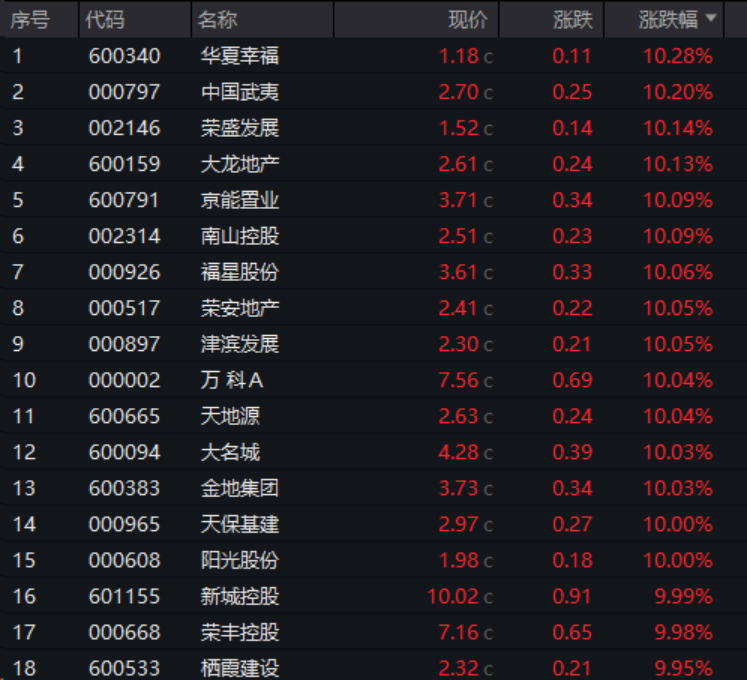
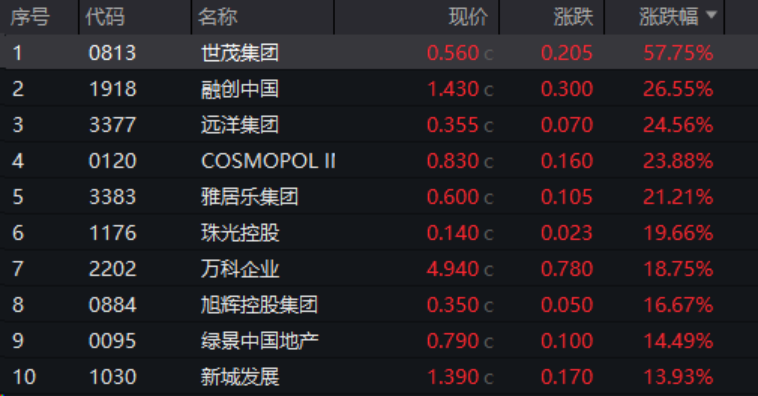
On April 29th, Vanke led the real estate stocks to counterattack. Wind real estate development plate rose by more than 6.79%. Nearly 30 shares of Huaxia Happiness, Vanke A and Xincheng Real Estate have daily limit. In terms of Hong Kong stocks, Shimao Group rose more than 70% in intraday trading, while Sunac China and Ocean Shipping Group all rose more than 20% in intraday trading.
In the news, following Nanjing’s policy of "non-Nanjing household registration personnel who have legally stable residences and actually live in the city can directly settle down", Chengdu has also liberalized the purchase restriction. It is rumored in the market that real estate-related policies will be further adjusted, and destocking has become one of the core concerns of the policy.
Market participants said in an interview with China, a brokerage firm, that there are many opinions on further relaxation of recent policies, and the market has further strengthened its loose judgment and made a more positive judgment on the real estate market outlook.
On April 29th, Vanke A opened rapidly, and closed the daily limit at around 10: 40, with a net capital inflow of 842 million yuan. Other real estate stocks have also made great strides. Among the constituent stocks of the Wind real estate development sector, 28 stocks including Huaxia Happiness have daily limit. Many of these stocks have also seen large amounts of money to buy. The net capital inflow of Poly Development was 170 million yuan, and that of gemdale was 123 million yuan.

In the Hong Kong stock market, the performance of some real estate stocks is even more fierce. Shimao Group rose more than 70% in intraday trading, and finally closed at 57.75%. Sunac China, Ocean Shipping Group and Agile Group all increased by more than 20%.
"Recently, some key cities have successively liberalized measures such as purchase restrictions, which has boosted market confidence." A real estate industry analyst of a Shanghai brokerage firm told the China reporter that Chengdu and Nanjing are relatively high in urban energy levels, and they are more attractive to the surrounding demand after fully liberalizing the purchase restriction. Nanjing even "bought a house and sent an account", and the relaxation intensity exceeded market expectations.
On April 22nd, Nanjing issued the "Notice on Matters Related to Legally Stable Residence (Draft for Comment)", which intends to further relax the conditions for settlement. Non-Nanjing household registration personnel who have legally stable residence and actually live in the city can directly settle down.
On April 28th, Chengdu Housing and Urban-Rural Development Bureau issued the Notice on Further Optimizing the Policies and Measures for the Stable and Healthy Development of the Real Estate Market. From April 29th, the commodity housing projects in Chengdu will no longer be subject to notarization and lottery, and will be sold by enterprises themselves. At the same time, according to the "Notice on Further Optimizing the Policies and Measures for the Stable and Healthy Development of the Real Estate Market", housing transactions in Chengdu will no longer review the conditions for purchasing houses such as household registration and social security, and will no longer limit the number of purchases.
Qi Dong, an analyst in the real estate industry of open source securities, said that housing-related policies at the local level have been introduced intensively, and Shenzhen and Nanjing have successively announced the implementation of the "trade-in" policy for commercial housing, aiming at stimulating the activity of the local property market. At the same time, Chengdu announced the lifting of the purchase restriction measures to promote the stable and healthy development of the real estate market. At present, the signal of stabilizing real estate is clear, and it is expected that the real estate policy will continue to be loose in the future, and there is still room for the release of housing demand. Mega-cities are actively and steadily promoting the transformation of villages in cities, and more countercyclical adjustment measures are expected to accelerate the landing.
In fact, while the benefits of urban policies in various cities continue to land, the market has also circulated a "small composition" with further loose policies at a higher level.
It is rumored in the market that the programmatic policies related to real estate will be further adjusted in the near future, and the main contents include "the focus of real estate policy has shifted to destocking; Let the city investment company and other companies purchase stock houses and turn them into rental houses; The demand policy can be fully liberalized, the purchase restriction can be liberalized, the price limit can be liberalized, and the deed tax can be uniformly reduced to 1%. "
Some market analysts believe that the relevant policies are feasible in practice. Yan Yuejin, research director of Yiju Research Institute, analyzed some rumors. For example, for the adjustment of demand side, he believes that the loosening of various places is increasing, and the house purchase policy basically cancels all kinds of binding policies since 2016, and even enters the historical stage of zero purchase restriction. The relaxation of price restrictions itself is also the logic of market price returning to market pricing. As for the deed tax policy, it can be considered that the transaction cost should be further reduced, because many standards of housing units or apartment types involved in deed tax policies around the country are the original models. Now the constraints on the second suite or apartment are reduced. From the perspective of adapting to the new situation of supply and demand, it is really necessary to adjust the deed tax policy to reduce transaction costs and improve efficiency.
Regarding the relevant contents of destocking, Yan Yuejin said that at present, the pressure of destocking of housing enterprises is still great, which affects the withdrawal of funds, so appropriate policy adjustments are also in line with expectations.
"The current situation of real estate really needs more policy support, otherwise it is difficult to get rid of difficulties by the industry itself. The authenticity of rumors cannot be confirmed now, but market expectations should be relatively consistent. " The aforementioned real estate industry analyst said.
Zhang Hongwei, founder of Mirror Consulting, said that the loose policies in core cities such as Chengdu have brought some positive market expectations, and it is expected that the policies in core cities will be further relaxed, which will help the market turnover to stabilize and rebound. These expectations are good for the stock price to rise.
According to the latest research report of CITIC Jiantou, since 2024, many key cities, including four first-tier cities, have gradually loosened the purchase restriction policy. Suzhou and Changsha have completely cancelled the purchase restriction before, and Hangzhou has cancelled the purchase restriction of second-hand houses. After the relaxation of the purchase restriction policy, the market responded positively. For example, Shanghai relaxed the purchase restriction for single non-registered people outside the Outer Ring Road in January. Due to the influence of the Spring Festival in February, the transactions of new houses and second-hand houses in March increased by 67.8% and 20.0% respectively compared with January, and Shenzhen reduced the requirement for payment of social security years in February. In March, new houses and second-hand houses increased by 26.1% and 14.2% respectively compared with January. The relaxation of the purchase restriction policy is of great significance for releasing the demand for buying houses and promoting the recovery of the property market. Cities that still retain the purchase restriction policy are expected to continue to relax in the future.